The AI Reasoning Architecture
July 29, 2026
Introduction:
Intelligence from data is abundant. Predictions, forecasts and classifications from tabular data are important tools in every enterprise AI strategy. This fundamental dependency on tabular data and AI models won’t disappear as AI agents get layered on top of business processes. In many cases, the underlying tabular data becomes even more load bearing as a primary content source, not less.
The most effective agent harnesses (Claude Code, Codex, Cursor) use output verification as a control loop to assure agentic work is demonstrably correct. Today this control loop over large-scale tabular data is intractable for LLMs. LLMs utilize text as their central units of reasoning. Tabular data represents information in rows and columns.
A new reasoning architecture is required for equipping agentic application harnesses with the control loop to reliably act on the intelligence from large-scale tabular data.
Addressing this problem from first principles, OuterProduct introduces this AI reasoning architecture, enriching tabular data from raw intelligence to actionable context and verified rules for agents to execute.
Evolving AI Reasoning:
The AI interpretability toolkit has been a natural candidate to bridge the gap between tabular intelligence and agents. But existing frameworks have exhibited unreliable accuracy and operational limitations of scale. As a result, they have generally served as tools for post-hoc regulatory compliance checkboxes in regulated industries.
Today, however, there are new reasoning frameworks. First introduced in our research 2x published in Science, and now productized in the Unified Reasoning Engine™, OuterProduct has built reasoning frameworks to bridge between the intelligence from large-scale tabular data with agentic applications.
The AI reasoning architecture:
The new reasoning architecture incrementally and progressively enriches the raw intelligence output by black-box tabular AI models with context, scenarios and strategies verified in data that agents can monitor and execute.
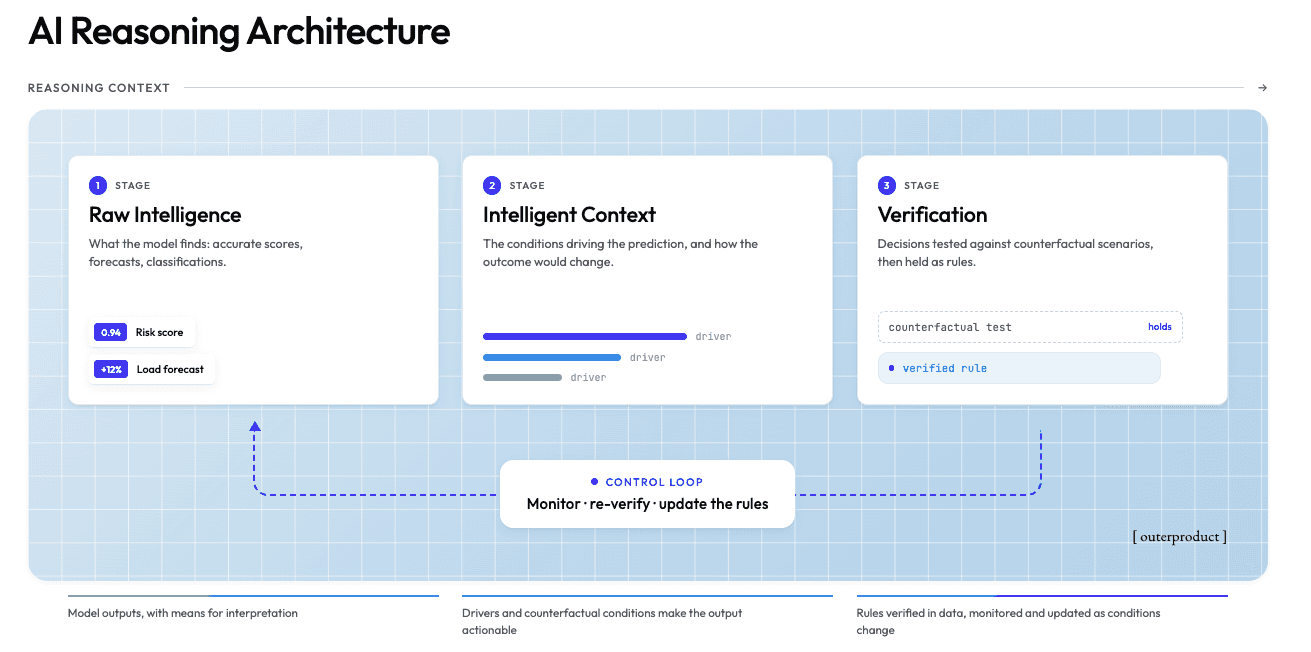
Raw Intelligence
Raw intelligence captures what a tabular model finds in the data. It produces highly accurate scores, forecasts, and classifications but does not characterize why these outputs are produced, or what to do about it.
Intelligent Context
The intelligent context layer enriches raw intelligence with conditions that drive the prediction. It identifies the specific drivers behind a prediction and how the outcome might change, to connect the result to an actionable decision.
Verification
The verification process tests decisions against counterfactual scenarios in the data before turning them into policy rules that agents can follow. It then monitors the results, checks whether the rules still hold, and updates them as conditions change.
Conclusion: Control Loop
The AI reasoning architecture presents a transformational opportunity to enforce a control loop over how AI agents utilize intelligence from large-scale tabular data to make decisions. The architecture ensures predictions are interpretable, and power decisions grounded in verified policies.